Normal View

Thursday, 16 Jul 2026

Written Answers Nos. 541-573

Cybersecurity Policy

Questions (541)

Pádraig Rice

Question:

541. Deputy Pádraig Rice asked the Minister for Health to provide further details regarding the cyberattack on the external provider of card printing services for the HSE; the type and volume of HSE records accessed in the attack; the timeline for notifying impacted individuals; the length of time she expects the pause on the production of cards to last; and if she will make a statement on the matter. [54517/26]

View answer

Written answers

As this is a service matter, I have asked the Health Service Executive to respond to the Deputy directly, as soon as possible.

Mental Health Services

Questions (542)

Joe Cooney

Question:

542. Deputy Joe Cooney asked the Minister for Health the budget allocation for mental health services for the years 2024, 2025 and to date in 2026, by health services region, in tabular form; her plans for increased investment in mental health services for 2027; and if she will make a statement on the matter. [54523/26]

View answer

Written answers

I thank the deputy for his question. The Government’s clear commitment to enhancing mental health services is shown by significant mental health funding increases in recent years. I would note that Budget 2026 saw a record allocation for mental health services of almost €1.6bn, up over 50% since I assumed the role of Minister for Mental Health in 2020.

The additional funding for current expenditure in Budget 2026 for the Health Vote is €1.5 billion, bringing the total current allocation to €25.8 billion. This includes funding to maintain existing levels of service and for new service developments, including funding for the recruitment of 300 additional whole time equivalent staff within Mental Health in 2026.

This is the sixth year in a row in which the mental health budget has been increased. This increase in funding for mental health services represents a significant investment which will enable continued policy implementation and service improvement in line with our national mental health policy, Sharing the Vision, and our national suicide and self-harm reduction strategy Connecting for Life, across a broad continuum from mental health promotion, prevention and early intervention, through to specialist mental health services.

This year’s budget provided the opportunity to focus on investing in crisis support and suicide prevention; youth mental health and CAMHS, and expanding the National Clinical Programmes.

The HSE has published its National Service Plan for 2026, setting out how the HSE will operationalise the Department’s priorities funded in Budget 2026, including the key priorities of improved access, quality and safety for those who use our services and value for money for the public more broadly.

The National Service Plan includes HSE plans, targets and timelines for specific measures to be progressed in 2026

The table below outlines the budget allocation for HSE Mental Health Services since 2024:

NSP Allocation

2024

2025

2026


€m

€m

€m

Mental Health

1,338

1,458

1,568

In Ireland, focusing solely on the health budget, Budget 2026 brought the mental health allocation to 6% of the total allocated health budget.

However, it should be noted that funding for mental health supports is dispersed across many areas of Government, and there is no single funding figure to reflect this. For example, the figure of just under €1.6 billion does not include funding for other parts of the health service that provide mental health supports, such as Primary Care, Disability services, liaison mental health in acute hospitals, some dual diagnosis (addiction and mental health) services, and mental health and well-being promotion.

It also does not include either spending by other Departments on services that incorporate psychological or mental health supports, such as Tusla, the Department of Education, the Prison and Probation Services, Youth Justice, or Social Protection

Health Services

Questions (543)

Pádraig Rice

Question:

543. Deputy Pádraig Rice asked the Minister for Health the options available to her should there be no meaningful increase in the number of public only consultant consultants working evening and Saturday shifts (details supplied); the steps she intends to take if the situation does not improve; and if she will make a statement on the matter. [54536/26]

View answer

Written answers

The Government’s objective is clear: the Public Only Consultant Contract must mean more timely care, more senior decision makers on site, better access to services outside traditional hours, and fuller delivery for public patients. The Minister does not expect every consultant to work every Saturday, this is about evenly distributing our resources, increasing senior decision maker presence across the week and moving towards a full six-day service in our hospitals.

Last year an agreement was reached on a Framework for extending working hours for all staff with all trade unions, which paves the way for broader implementation of extended services. The six Regional Clinical Directors are due to meet with the Cabinet Committee on Health Today to inform them of their plans to improve evening and weekend rostering. Staff numbers within the HSE have grown by approximately 30% since the end of 2019. This investment shows the government is committed to putting the resources in place to facilitate extended hours across the health service.

Ahead of meet the Cabinet Committee meeting, The HSE Chief Clinical Officer has written to clinical directors requiring a review of all current rosters to ensure extended hours and Saturday working are scheduled and staffed in line with clinical service need. The HSE has governance and programme structures in place to strengthen oversight, reporting and accountability, and that work now needs to translate into more consistent extended-day and weekend rostering across the system.

Hospital Services

Questions (544)

Robert O'Donoghue

Question:

544. Deputy Robert O'Donoghue asked the Minister for Health whether she is aware that patients presenting to hospitals requiring urgent gynaecological ultrasound investigations are, in some cases, being discharged or referred elsewhere because ultrasound services are unavailable at weekends; the number of hospitals affected by this issue; and if she will make a statement on the matter. [54537/26]

View answer

Written answers

As this is a service matter, I have asked the Health Service Executive to respond to the Deputy directly, as soon as possible.

Hospital Services

Questions (545)

Robert O'Donoghue

Question:

545. Deputy Robert O'Donoghue asked the Minister for Health whether the HSE has conducted a review of weekend diagnostic imaging services for gynaecology patients; if so, the findings of that review; and if she'll publish the review. [54538/26]

View answer

Written answers

As this is a service matter, I have asked the Health Service Executive to respond to the Deputy directly, as soon as possible.

Women's Health

Questions (546)

Robert O'Donoghue

Question:

546. Deputy Robert O'Donoghue asked the Minister for Health whether she will provide increased, ring-fenced investment for women’s healthcare in budget 2027 to address longstanding gaps in the provision of services across the health system, including preventative care, diagnostics, gynaecology, reproductive health, menopause care, chronic pain services, and community-based supports; the level of additional funding being considered; the priority areas for investment; and if she will make a statement on the matter. [54539/26]

View answer

Written answers

Underscoring the Government’s commitment to Women’s Health has been the investment of dedicated additional funding of over €180 million since 2020. This dedicated funding has resulted in new and often first-of-their-kind initiatives across the country The Women’s Health Fund was established in 2021 to support the implementation of priority actions identified by the Women’s Health Taskforce and outlined in the Women’s Health Action Plans. It has invested in over 100 initiatives to date and will continue to support the implementation of this Women’s Health Action Plan.

The Women’s Health Action Plan 2022-23 was published in March 2022, marking International Women’s Day. The Action Plan identified key actions to improve health outcomes and experiences for women in Ireland. It provided the foundation to address women’s health as a whole and helped to ensure that women’s health is viewed beyond reproductive health in order to make a real difference to women’s lives.

The Women’s Health Action Plan 2024-2025 Phase 2: An Evolution in Women’s Health was published in April 2024. This Action Plan represents the next phase in women's health. It continues to embed and build on the significant work completed under the previous Women’s Health Action Plan 2022-2023, as well as having a focus on new and innovative developments. The Action Plan also has a specific spotlight on women at midlife and older and marginalised women

 The Women’s Health Action plan 2026-2027: Phase 3  was published 8th July 2026, seeks to continue to embed and upscale women’s health initiatives put in place by the previous two Action Plans, build on our knowledge of women’s health through research and innovation and spotlight key areas including endometriosis and cardiovascular disease. Many of the actions within this plan have been initiated via funding from the 2026 budgetary process.

In addition to embedding the initiatives introduced over the past four years, some of the developments which will take place in the lifetime of this action plan are set out below.

The Women’s Health Action Plan 2026-27 (Phase 3) outlines key actions which include:

• A focus and investment in research, evidence, data collection and innovation, including €2million in ringfenced funding for women’s health research for 2026 and 2027.

• Enhanced access to proactive and preventative healthcare to support a better quality of life e.g. screening, early detection and prevention of cardiovascular disease in young women and exploration of a Women’s Health Programme in General Practice. 

• Embedding and upscaling women’s health initiatives put in place through the implementation of the Women’s Health Action Plans 1 & 2 (Free Contraception Scheme, Specialist Menopause Clinics, Mental Health Services, Ambulatory Gynaecology Clinics, Postnatal Hubs).

• We will continue the expansion programme for Ambulatory Gynaecology Clinics.

• We will extend the range of services offered in the Specialist Menopause Clinics.

• Expansion of the free period products scheme to new locations.

• Increase the number of Postnatal Hubs nationally to 13 by establishing 4 more hubs in Waterford, Limerick, Cavan and Letterkenny in 2026.

• Promotion of social inclusion, connectedness and equity to improve experiences of marginalised groups of women.

• We will target awareness, education and signposting of women’s health conditions and services.

• We will spotlight key areas that women and girls have asked us to prioritise, including endometriosis and cultural and gender sensitivity awareness for healthcare professionals.

• Initiatives to promote and develop the delivery of women’s health services through local pharmacies.

• We will support the implementation of new and ongoing initiatives and technologies to enhance the BreastCheck service.

• We will continue to progress, in line with policy objectives, the further development of the Model of Care for Fertility and publicly funded Assisted Human Reproduction treatment and services, including the full operationalisation of the first public Assisted Human Reproduction Centre in Cork

This Government is committed to Progressing and Promoting Women’s Health through targeted funding via the Women’s Health Fund and implementation of the Women’s Health Action Plan 2026-2027.

Nursing Homes

Questions (547)

William Aird

Question:

547. Deputy William Aird asked the Minister for Health if she will provide an update on the multi-annual Reform, MAR, pricing roadmap for nursing homes; when the next increase in the MAR threshold will be implemented; whether greater transparency will be provided regarding future adjustments; and if she will make a statement on the matter. [54575/26]

View answer

Written answers

This PQ is relevant to the Dept. of Enterprise Trade and Employment. As such the Deputy should direct this question to my colleague, the Minister for Enterprise Trade and Employment.

Nursing Homes

Questions (548)

William Aird

Question:

548. Deputy William Aird asked the Minister for Health if she will outline the steps being taken to develop a national career pathway for healthcare assistants working in the nursing home sector; and if she will make a statement on the matter. [54576/26]

View answer
Reply not received from Department.

Nursing Homes

Questions (549)

William Aird

Question:

549. Deputy William Aird asked the Minister for Health if she will consider introducing targeted financial supports for private and voluntary nursing homes to assist with increased energy and fuel costs; and if she will make a statement on the matter. [54577/26]

View answer

Written answers

The sustainability of the Nursing Home sector in Ireland is a priority for this government, and unprecedented levels of funding, investment and support has been provided over the last number of years to stabilise the sector.

Budget 2026 has seen an investment of over €1.3 billion in the Nursing Home Support Scheme (NHSS). An additional €92.2 million was allocated to support nursing homes in Budget 2026 including a new €10 million fund to support private and voluntary nursing homes for structural/other improvement works carried out to enhance the resident environment.

Successive increases in NHSS funding have seen the Scheme's budget grow from €968 million in 2019 to over €1.3 billion in 2026. Together with resident contributions of approximately €400 million each year, this represents total funding of more than €1.7 billion to support nursing home care in 2026.

Department officials continue to monitor the sustainability of the nursing home sector, taking account of prevailing conditions across the sector.

Nursing Homes

Questions (550)

William Aird

Question:

550. Deputy William Aird asked the Minister for Health if she will confirm whether the residential environment enhancement scheme will be extended beyond 2026; and if she will make a statement on the matter. [54578/26]

View answer

Written answers

In April this year, I announced the new €10 million Nursing Home Resident Environment Enhancement (REE) Scheme. The REE Scheme aims to support private and voluntary nursing homes to carry out structural and other improvement works that enhance the day-to-day living environment for residents.

The REE Scheme provides targeted funding for structural/other works carried out to specifically enhance the resident environment, safety and facilities in nursing homes in compliance with Regulation 17 (Premises) as it applies to internal and external communal spaces for residents, their bedrooms/bathrooms, and equipment, furniture and furnishings for use by residents.

This REE Scheme is open to all operational voluntary and private nursing homes registered with the Health Information and Quality Authority (HIQA) and the National Treatment Purchase Fund (NTPF) as of 1 January 2026, and in receipt of payment under the National Nursing Homes Support Scheme (NHSS) for the provision of long-term residential care services. Up to €25,000 is available to each qualifying nursing home. Eligible nursing homes may claim for works carried out between 1 January 2025 and 20 November 2026 that meet the scheme criteria.

The Scheme opened for applications on the 16th April 2026 and will close on the 20th November 2026.

The Nursing Home Resident Environment Enhancement Scheme is a time-limited measure for 2026.

Nursing Homes

Questions (551)

William Aird

Question:

551. Deputy William Aird asked the Minister for Health when the Government intends to deliver on its Programme for Government commitment to introduce an equitable funding model or the nursing homes support scheme (fair deal); and if she will make a statement on the matter. [54579/26]

View answer

Written answers

In December 2021, the Department published the independently chaired Value for Money (VFM) review on nursing home costs. The VfM Review and the Department of Health response to the findings and recommendations following publication can be found at the following link: www.gov.ie/en/department-of-health/publications/a-value-for-money-review-of-nursing-home-care-costs/

The VfM Review made nine recommendations which the Department continues to take forward.

Arising from the VfM Review, a steering group has been established to oversee the delivery of the recommendations from a National Treatment Purchase Fund (NTPF) Review of the Pricing System; this group has met on a regular basis since publication of the review. The group made four recommendations:

• Recommendation 1: formal assessment of using a formulaic approach in the pricing system as set out in Section 4 of the Report.

• Recommendation 2: formal assessment of amending the approach to the assessment of “Local Market Price” to reflect prices within other nursing homes within a certain distance of the nursing home rather than within the same county.

• Recommendation 3: NTPF to engage with nursing homes and their representatives in relation to enhancing the internal NTPF Review process.

• Recommendation 4: amending the process for allowing for high dependency residents when the necessary systems are in place

The delivery of recommendations 1-3 primarily sit with the NTPF. As per the recommendations of the review, the NTPF is reporting periodically to the steering group on progress in implementing the recommendations. It is recognised, however, that recommendation 4 has dependencies going well beyond the scope of the pricing review. This recommendation is therefore being addressed within the broader context of the reform of older persons' services, with appropriate links established between the pricing review steering group (including shared membership) to ensure that appropriate links are made between this recommendation and the others.

Publication of the final report has been placed on hold by the NTPF following legal advice. A decision on next steps will be made following analysis of the final report.

The Government continues to progress its Programme for Government commitment to publish the NTPF review of pricing systems and work towards an equitable funding model for the nursing home sector.

Nursing Homes

Questions (552)

William Aird

Question:

552. Deputy William Aird asked the Minister for Health if she will provide an update on the development of a National Nursing Home Care Policy; the resources that have been allocated to support its preparation; the expected timeline for its publication; and if she will make a statement on the matter. [54580/26]

View answer

Written answers

The Government is committed to ensuring that older people have access to high-quality, person-centred care and supports, including residential care where required. Substantial policy and reform work is ongoing in respect of nursing homes and long-term residential care. The future strategic direction for nursing home and wider older persons' care policy is being informed by the work of the independent Commission on Care for Older People, which was established in 2024 in fulfilment of a commitment in the Programme for Government.

The Commission is examining the effectiveness, adequacy and efficiency of the health and social care services and supports currently provided to older people, including home-based supports, community services and residential care across low-, medium- and high-support settings. Following completion of its work, the Commission will make recommendations to Government to inform the future strategic development of services and supports for older people.

In Budget 2026, €0.735 million was allocated to support the work of the Commission.

It is expected that Module 1, which examines the current provision of health and social care services and supports for older people, will be published in autumn 2026. Module 2, which commenced in January 2026, is developing a framework for the overarching strategic development of health and social care services and supports for older people.

In Module 3 a cross-departmental group will be established under the auspices of the Commission to consider whether the mainstreaming of ageing across Government and civil society is effective in supporting citizens’ healthy, positive, and autonomous ageing; and to develop costed policy options to support this where necessary.

The Programme for Government 2025 contains a commitment to publish, resource and implement a National Action Plan for Older Persons' Care, taking account of the Commission's findings and recommendations. This Action Plan will examine and enhance the mix of professional care options available to older people and support timely access to comprehensive and affordable long-term care services.

Home Care Packages

Questions (553)

William Aird

Question:

553. Deputy William Aird asked the Minister for Health if she will outline the process by which recipients of HSE-funded home support may request a change of home care provider; whether the HSE will introduce a clear national pathway to allow clients to transfer their HSE-funded home support hours from one approved provider to another; and if she will make a statement on the matter. [54581/26]

View answer

Written answers

As this is a service matter, I have asked the Health Service Executive to respond to the Deputy directly, as soon as possible.

Home Care Packages

Questions (554)

William Aird

Question:

554. Deputy William Aird asked the Minister for Health if she will consider facilitating recipients of HSE-funded home supports who wish to receive both their publicly-funded and privately-funded home care services from the same provider in order to improve continuity of care and reduce the number of carers entering their home; and if she will make a statement on the matter. [54582/26]

View answer

Written answers

As this is an operational matter, I have asked the Health Service Executive to respond to the Deputy directly as soon as possible.

Primary Care Centres

Questions (555)

Fionntán Ó Súilleabháin

Question:

555. Deputy Fionntán Ó Súilleabháin asked the Minister for Health whether a successful tenderer was notified in quarter two of 2026 for a care centre (details supplied); whether a timeline for the project is now available; and if she will make a statement on the matter. [54583/26]

View answer

Written answers

As the Health Service Executive (HSE) holds responsibility for the provision, along with the maintenance and operation of Primary Care Centres, I have asked the HSE to respond to the Deputy directly, as soon as possible.

EU Presidency

Questions (556)

Robert O'Donoghue

Question:

556. Deputy Robert O'Donoghue asked the Minister for Health the number of EU Presidency policy and administrative officers now employed on temporary contracts across her Department, in Ireland and abroad; if these individuals can apply to internal civil service competitions for these temporary contracts; the plans being developed to retain these individuals once their contracts cease, given they will have extensive and intimate knowledge of EU and Irish institutional operations; and if she will make a statement on the matter. [54596/26]

View answer

Written answers

The Department is currently supported by one temporary EU Presidency Policy Officer and one temporary Administrative Officer, both of whom are locally engaged staff based at Ireland's Permanent Representation in Brussels. As locally recruited staff, they are not eligible to apply for internal Civil Service competitions and their contracts will end on completion of Ireland's Presidency. All other Presidency-related roles are filled by established civil servants who, following the Presidency, will be redeployed within the Department to address existing vacancies and business priorities.

Health Services

Questions (557)

Pádraig Rice

Question:

557. Deputy Pádraig Rice asked the Minister for Health the status of a proposal to introduce publicly funded pre-natal testing (details supplied); the date on which she received the initial proposal; the date on which she received the revised proposal; the timeline she is working towards in concluding the negotiations; the expected cost; and if she will make a statement on the matter. [54604/26]

View answer

Written answers

I and this government are committed to ensuring fair access to high-quality maternity and reproductive healthcare services.

Congenital anomalies affect approximately 2–3% of pregnancies in Ireland, with aneuploidy being a leading cause of foetal and neonatal mortality. The development of a National Prenatal Screening Programme, including non-invasive prenatal screening (NIPS) for aneuploidy, has been recommended by both the O’Shea Review and the Regan Review conducted under Section 11 of the Health (Regulation of Termination of Pregnancy) Act 2018. The Government is giving active consideration to proposals for a publicly funded NIPS/NIPT programme through the HSE planning and service development process. The proposal remains under review, with ongoing engagement between the HSE and the Department of Health regarding the policy, clinical and funding requirements necessary to support its implementation.

Hospital Staff

Questions (558)

Pat Buckley

Question:

558. Deputy Pat Buckley asked the Minister for Health the reason paediatric epilepsy nurse service will be unavailable at Cork University Hospital from 3 July 2026; and the steps she is taking to ensure that this service resumes as a matter of urgency. [54613/26]

View answer

Written answers

As this is a service matter, I have asked the Health Service Executive to respond to the Deputy directly, as soon as possible.

Climate Action Plan

Questions (559)

Pa Daly

Question:

559. Deputy Pa Daly asked the Minister for Health the position regarding all actions in each of the climate action plans 2021 to 2025 under the remit of her Department; to provide a breakdown of the legacy actions remaining, broken down by the year of the climate action plan they were initially included in; and the estimated timelines for completion, in tabular form. [54631/26]

View answer

Written answers

Ireland's whole-of-Government response to the challenges of climate change has been embedded in annual cross-sectoral Climate Action Plans since the first Plan in 2019. These include cross-sectoral actions, as well as commitments by individual Government Departments and Agencies, with a focus on the achievement of Ireland's domestic and international emission-reduction commitments.

While the health sector does not have an emissions ceiling or a carbon budget, its actions and commitments under the Climate Action Plan process have both supported cross-sectoral efforts at reducing Ireland's carbon footprint and begun the process of reducing the health impacts of climate change. In addition, the sector is covered by Ireland's public sector climate action mandate obligations in relation to energy efficiency and energy usage. 

The relevant actions under each Climate Action Plan, and an implementation update, are set out in the attached table.

Health sector climate action is also supported by both the HSE Climate Action Strategy 2023-2050, and the Health Sectoral Adaptation Plans which cover the periods 2019-2024 and 2025-2030.

PQ54361 Supplementary Table.

Covid-19 Pandemic

Questions (560)

Gillian Toole

Question:

560. Deputy Gillian Toole asked the Minister for Health the differentiating factors between long-Covid and vaccine adverse events; the process of evaluation of differentiation is carried out, by data sources, public consultation and any other relevant metrics; and if she will make a statement on the matter. [54651/26]

View answer

Written answers

As this is a service matter, it has been referred to the Health Service Executive for attention and direct reply to the Deputy.

Weather Events

Questions (561, 562)

Roderic O'Gorman

Question:

561. Deputy Roderic O'Gorman asked the Minister for Health if her Department or the HSE has collected statistics on excess heat related deaths in Ireland due to the heat wave experienced at the end of May 2026; and if she will make a statement on the matter. [54654/26]

View answer

Roderic O'Gorman

Question:

562. Deputy Roderic O'Gorman asked the Minister for Health her Department’s policy with respect to the collection of data related to heatwave events, in particular, excess mortality due to heat; and if she will make a statement on the matter. [54655/26]

View answer

Written answers

I propose to take Questions Nos. 561 and 562 together.

The Department of Health does not produce estimates of excess mortality. However, the Department works closely with the HSE-Health Protection Surveillance Centre (HPSC) and other stakeholders to monitor estimates of excess mortality. 

Excess mortality is a term used in epidemiology and public health that refers to the number of deaths from all causes during a period of time above and beyond what we would have normally expected to see. Excess deaths are typically defined as the difference between the observed number of deaths in a specific time-period and the expected number of deaths during the same time-period.

A number of different methodologies have been developed internationally to try to estimate levels of excess mortality. All of these methodologies are statistical techniques to estimate excess mortality based on all-cause mortality data.   

In Ireland, the HSE-Health Protection Surveillance Centre (HPSC) receives daily registered deaths data from the General Register Office (GRO) on all deaths from all causes registered in Ireland. These data have been used since 2009 to monitor excess all-cause deaths in Ireland as part of a wider European Mortality Monitoring Project known as EuroMOMO www.euromomo.eu/[]

EuroMOMO is a European mortality monitoring activity, aiming to detect and measure excess deaths related to seasonal influenza, heatwaves and other public health threats.  EuroMOMO publishes a weekly update of estimates of excess mortality, by age group, for all participating European countries see www.euromomo.eu/graphs-and-maps[] This is the main indicator of excess mortality used in Ireland and by the Department.

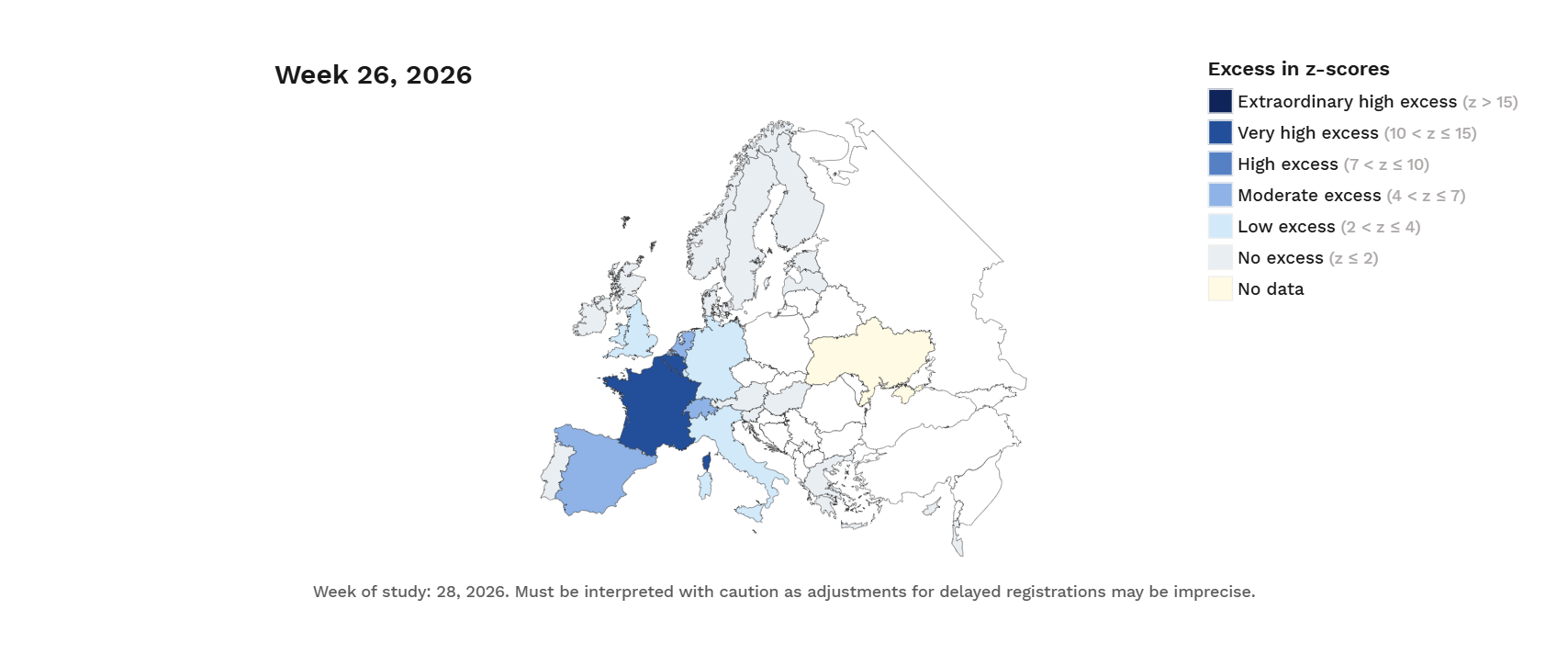
EuroMOMO publish estimates in the form of z-scores. A z-score is a statistical measure that describes how far away from the mean a given data point is. In this context, if the observed number of deaths is the same as the expected number of deaths, the z-score is 0. The greater distance the observed number of deaths is from the expected number, the higher the z-score will be.

Weeks where the z-score is less than or equal to 2 are considered to not have any excess mortality. Where the z-score is greater than 2 but less than or equal to 4 is considered to be low excess; greater than 4 but less than or equal to 7 is considered to be moderate excess; and a z-score of 7 or higher is considered high excess. 

The latest data published by EuroMOMO relates to Week 27 2026. For Ireland, no excess mortality has been recorded since Week 8 2026 (see attached chart).  It should be noted that for more recent periods, these data are provisional due to the time lag with death registration in Ireland. A country-specific adjustment function is applied to correct for the typical lag in registrations of deaths in Ireland (the legal period for death registration in Ireland is currently three months). Nonetheless, estimates of excess mortality for the most recent weeks are reported with some uncertainty and should be interpreted with caution.  EuroMOMO estimates of excess mortality are revised each week as additional data becomes available.

More broadly, the latest EuroMOMO bulletin noted that ‘This week’s pooled EuroMOMO estimates of all-cause mortality for the participating European countries show increased mortality around week 26, 2026. The increase is mainly seen in age groups above 45 years, particularly affecting some countries.’  The map attached shows the z-scores for Week 26 2026 for participating European countries with France and Belgium showing very high excess mortality and a number of other countries showing moderate or low excess mortality.  

The Department of Health, together with the HSE-Health Protection Surveillance Centre (HPSC), continues to monitor estimates of excess mortality produced by EuroMOMO weekly.PQ_EuroMOMO_charts-z-scores-ireland.png

PQ_EuroMOMO_map-z-scores-Week 26 2026.png

Question No. 562 answered with Question No. 561.

Ambulance Service

Questions (563)

Brendan Smith

Question:

563. Deputy Brendan Smith asked the Minister for Health the progress to date in improving ambulance waiting times in the north-east including in Cavan-Monaghan; and if she will make a statement on the matter. [54666/26]

View answer

Written answers

As this is a service matter I have asked the Health Service Executive (HSE) to respond to the Deputy directly, as soon as possible.

Health Services

Questions (564)

Marie Sherlock

Question:

564. Deputy Marie Sherlock asked the Minister for Health when the national breastfeeding strategy will be published; and if she will make a statement on the matter. [54674/26]

View answer

Written answers

Encouraging mothers to breastfeed is a priority for the Department of Health. National Health policy, including the Healthy Ireland Framework, the National Maternity Strategy, the Obesity Policy and Action Plan, and the National Cancer Strategy, emphasises the importance of supporting mothers who breastfeed, as well as taking action to increase breastfeeding rates in Ireland. The HSE Breastfeeding in a Healthy Ireland Action Plan is the framework for progressing supports for breastfeeding in Ireland. 

The Government is committed to increasing resources and supports for new mothers in Ireland. There has been a four-fold increase in Specialist Lactation Consultant whole time posts since 2017 and there are over two hundred community breastfeeding support groups in operation. In 2025 and 2026, the Government has provided additional funding for breastfeeding pumps for critically unwell and premature infants of €300k. 

The Department completed a breastfeeding consultation process with independent consultancy firm MCCP. The findings from these stakeholder consultations will assist the development of a new breastfeeding strategy. The Department are currently developing a new breastfeeding strategy, which will be published by the end of the year.


Medicinal Products

Questions (565)

Jennifer Whitmore

Question:

565. Deputy Jennifer Whitmore asked the Minister for Health if there are pathways for women using trial drugs to treat adenomyosis to have their costs fully or partially covered by the State; and if she will make a statement on the matter. [54676/26]

View answer

Written answers

Under the Health (Pricing and Supply of Medical Goods) Act 2013, the HSE has statutory responsibility for decisions on the pricing and reimbursement of medicines and devices.

There is a National Application, Assessment & Decision Process for new medicines which is underpinned by Primary Legislation (Health (Pricing and Supply of Medical Goods) Act 2013) put in place by the Oireachtas. The HSE must comply with the relevant legislation when considering investment decisions around new medicines.

The HSE must robustly assess applications for pricing and reimbursement to make sure that it can stretch available resources as far as possible and to deliver the best value in relation to each medicine and ultimately more medicines to patients in Ireland.

Pharmaceutical companies are required to submit formal applications to the HSE if they wish for their medicines to be added to the list of reimbursable items / funded via hospitals. The decision of pharmaceutical companies to market licensed medicines i.e. whether or not to submit a formal application, is outside the control of the HSE.

The European Medicines Agency (EMA) is a centralised agency of the European Union (EU) responsible for the scientific evaluation, supervision and safety monitoring of medicines in the EU. The EMA plays an integral role in the authorisation of medicines in the EU via the centralised procedure. The Health Products Regulatory Authority (HPRA) is the competent authority responsible for the regulation of human medicines in Ireland. A company can submit an application for a marketing authorisation directly to the HPRA if the product in question is not required to be approved through the centralised procedure.  

As outlined above, the national assessment and decision process for pricing and reimbursement cannot commence in the absence of marketing authorisation.

Health Services

Questions (566)

Marie Sherlock

Question:

566. Deputy Marie Sherlock asked the Minister for Health the timeline for when her Department will develop a breastfeeding awareness campaign as per the Women’s Health Action Plan; and if she will make a statement on the matter. [54677/26]

View answer

Written answers

Encouraging mothers to breastfeed is a priority for the Department of Health. National Health policy, including the Healthy Ireland Framework, the National Maternity Strategy, the Obesity Policy and Action Plan, and the National Cancer Strategy, emphasises the importance of supporting mothers who breastfeed, as well as taking action to increase breastfeeding rates in Ireland.

Improved supports for breastfeeding has been included in both Women's Health Action Plans since first publication in 2022. This includes initiatives such as:

• Funding provided under the first Women's Health Action Plan 2022-2023 supported the provision of an additional 24 Lactation Consultants to support new mothers in both maternity and primary care settings to breastfeed their infants.

• Support for the development and publication of an Irish College of General Practitioners Quick Reference Guide on Breastfeeding; an evidence-based guide for GPs to promote breastfeeding and improve support in general practice for women considering breastfeeding. 

• Investment in 2025, including investment through the Women's Health Action Plan 2024-2025, will bring the national network of Postnatal Hubs to a total of 13. The hubs support women for up to 14 days post-birth by addressing many of the gaps identified by women in postnatal care including education, breastfeeding, physiotherapy, emotional, and physical supports.

• The Women's Health Action 2024-2025 commits to continuing to implement our existing strategies that support women at all life stages; including the Breastfeeding Action Plan. 

The HSE Breastfeeding in a Healthy Ireland Action Plan is the framework for progressing supports for breastfeeding in Ireland. 

The HSE has undertaken a range of breastfeeding awareness and promotion campaigns in recent years as part of its commitment to supporting breastfeeding and improving awareness of available breastfeeding services and supports.

A key annual initiative is National Breastfeeding Week, which takes place each year from 1–7 October. To support this national campaign, promotional materials are distributed to community healthcare services and maternity hospitals nationwide. HSE Communications works in partnership with the National Healthy Childhood Programme (NHCP) to deliver media and awareness activities during the week, including staff profiles, news articles, parent stories and feature content. These communications highlight the benefits of breastfeeding, promote available support services and target key audiences including parents, parents-to-be and healthcare professionals.

In addition to National Breastfeeding Week, the HSE promotes breastfeeding year-round through mychild.ie platform, its trusted source of evidence-based information for parents-to-be and parents of young children. The mychild.ie website includes information on breastfeeding, pregnancy, parenting and child health, and received 4.9 million views in 2025, of which there were more than half a million views of breastfeeding specific web pages. The mychild.ie website provides a wide range of breastfeeding resources, including more than 50 online breastfeeding guides, a breastfeeding support group search facility and access to the Ask Our Breastfeeding Expert service. The Breastfeeding Support Group Finder currently lists over 240 breastfeeding support services and groups nationwide, helping parent’s access local support in both community and healthcare settings. In the last year, approximately 2,250 breastfeeding-related queries were answered through the online Ask Our Expert service.

Breastfeeding information and support services are promoted through multi-channel communications activities/campaigns, including television, radio, digital, social media (dedicated mychild.ie www.facebook.com/HSEmychild.ie[] and https://eur04.safelinks.protection.outlook.com/?url=https%3A%2F%2Fwww.instagram.com%2Fhse_mychild%2F&data=05%7C02%7CSarah_Reilly%40health.gov.ie%7C3b68b92d60cb44e2f5d008dee32fda86%7Cf054526a6bcc4a789984faa3ff4555b0%7C0%7C0%7C639197991879019186%7CUnknown%7CTWFpbGZsb3d8eyJFbXB0eU1hcGkiOnRydWUsIlYiOiIwLjAuMDAwMCIsIlAiOiJXaW4zMiIsIkFOIjoiTWFpbCIsIldUIjoyfQ%3D%3D%7C0%7C%7C%7C&sdata=Vpj6QbYWSSOqFmLc2s58maVLtJtaI2X1VrXVUgKbiKw%3D&reserved=0), online video, search, and print advertising which promote breastfeeding information, resources and supports throughout the year

The HSE MyChild campaign activity includes paid advertising on social media and media campaigns to direct parents and expectant parents to breastfeeding information and support services, including information on the MyChild.ie website, Breastfeeding Support Group Finder and the Ask Our Breastfeeding Expert service.

The HSE provides all parents with a series of free information books at key stages of pregnancy and early childhood which contain practical information on pregnancy, breastfeeding, parenting and child health, and include details of available breastfeeding supports and services:

• My Pregnancy Book, provided during the antenatal period;

• My Child: 0–2 Years; and

• My Child: 2–5 Years.

The HSE also supports breastfeeding awareness and education through webinars and educational events for healthcare professionals and voluntary breastfeeding support organisations.

The HSE will continue to promote breastfeeding through National Breastfeeding Week, ongoing communications campaigns, mychild.ie resources and the provision of breastfeeding support services. Planning for future annual National Breastfeeding Week campaigns forms part of ongoing HSE communications and health promotion activities.

The Department completed a breastfeeding consultation process with independent consultancy firm MCCP. The findings from these stakeholder consultations will assist the development of a new breastfeeding strategy. Breastfeeding awareness campaigns will be considered  as part of the development of the new strategy. The Department are currently developing a new breastfeeding strategy, which will be published by the end of the year. 

Dental Services

Questions (567)

David Cullinane

Question:

567. Deputy David Cullinane asked the Minister for Health the number of patients on waiting lists for access to dental treatment under sedation at the end of July 2026, by sedation type, by patient type, by wait time band, for each health area, by region, in tabular form. [54695/26]

View answer

Written answers

As this is a service matter, I have asked the Health Service Executive to respond to the Deputy directly.

Medical Cards

Questions (568)

David Cullinane

Question:

568. Deputy David Cullinane asked the Minister for Health the number of requests received to date in 2026 for assistance with assignment to a GP or a dentist for medical card holders, free GP card holders, or by persons without such qualification, by area, in tabular form. [54696/26]

View answer

Written answers

As this is a service matter, I have asked the HSE to reply to the Deputy directly as soon as possible.

General Practitioner Services

Questions (569, 575)

David Cullinane

Question:

569. Deputy David Cullinane asked the Minister for Health the number of GPs and GPs providing GMS services, by local health area and per 10,000 population, at the end of July 2026 compared to end of July 2025, in tabular form. [54697/26]

View answer

David Cullinane

Question:

575. Deputy David Cullinane asked the Minister for Health the number of GPs and GPs providing GMS services, by local health area and per 10,000 population, in the past five years to end of July 2026, in tabular form. [54703/26]

View answer

Written answers

I propose to take Questions Nos. 569 and 575 together.

As this is a service matter, I have asked the HSE to reply to the Deputy directly as soon as possible. 

Please note that as GPs are private practitioners, accordingly it may only be possible for the HSE to respond in relation to HSE-contracted GPs.

Hospital Staff

Questions (570)

David Cullinane

Question:

570. Deputy David Cullinane asked the Minister for Health the total spend by the HSE and section 38 hospitals on agency staffing and recruitment services to date in 2026; and the performance and variance against targets, by region, in tabular form. [54698/26]

View answer

Written answers

As this is a service matter, I have asked the Health Service Executive to respond to the Deputy directly, as soon as possible.

Departmental Expenditure

Questions (571)

David Cullinane

Question:

571. Deputy David Cullinane asked the Minister for Health the management consultancy and external professional services spend by the HSE, by firm and service type, to date in 2026 compared to same year to date in 2025, tabular form. [54699/26]

View answer

Written answers

As this is a service matter, I have asked the Health Service Executive to respond to the Deputy directly, as soon as possible.

Departmental Expenditure

Questions (572)

David Cullinane

Question:

572. Deputy David Cullinane asked the Minister for Health the management consultancy and external professional services spend by each section 38 organisation, by firm and service type, to date in 2026 compared to year to date in 2025, in tabular form. [54700/26]

View answer

Written answers

As this is a service matter, I have asked the Health Service Executive to respond to the Deputy directly, as soon as possible.

Departmental Legal Cases

Questions (573, 579)

David Cullinane

Question:

573. Deputy David Cullinane asked the Minister for Health the total cost of medical negligence litigation, including settlements, awards, and legal fees, to date in 2026, in tabular form. [54701/26]

View answer

David Cullinane

Question:

579. Deputy David Cullinane asked the Minister for Health the total cost of medical negligence litigation, including settlements, awards, and legal fees, in the past five years to end of July 2026, in tabular form. [54707/26]

View answer

Written answers

I propose to take Questions Nos. 573 and 579 together.

The State Claims Agency (SCA) has a statutory remit to manage personal injury and third-party property damage claims on behalf of State authorities.

The information contained within this response is extracted from the National Incident Management System (NIMS) as per the below criteria.

The following table contains the transactional amounts paid by the State Claims Agency under the Clinical Indemnity Scheme, that are associated with claims and a small number of incidents and inquests. It excludes claims recorded against other designated schemes. This amount includes damages, agency legal and other costs, and plaintiff legal costs and is inclusive of VAT.

It includes payments between 01/05/2026 and 30/06/2026 and is correct as of 01/07/2026.

Please note that the amounts paid up to 30/04/2026 remain unchanged from those previously provided under references PQ 3529/25, PQ 38143/25, PQ 6229/26 and PQ 41309/26. Please refer to the published information for further details.

Transaction Reporting Year

Amount paid

2026 (May and June)

€64,272,204